If you haven’t found a favorite film before the year ends, SAKKA invites you to a limited time screening of Mirrorliar Films vol. 3 & 4, starting from October 2nd till 24th. As a passion project launched by Abe Shinnosuke, Yamada Takayuki and Ito Chikara, the Mirrorliar Films project is an easy gateway to a wide spectrum of filmmakers and actors across genres and styles.
We at PD got in on an early viewing, and, to make the choice a little easier for everyone else, decided to each name one project that stood out to us.
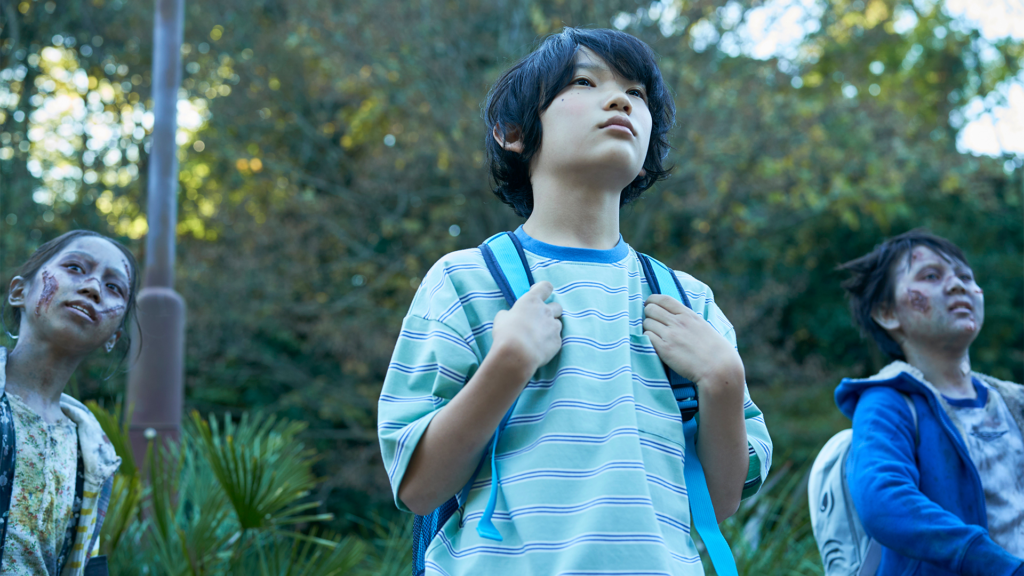
ENDANGERED SPECIES / ZETSUMETSUKIGUSHU (By Rei)
Dir. Nozaki Hirotaka (2022, ML-Vol.3)
Cast: Hirano Kouga, Takeuchi Ichika, Raimu, Hara Fukiko, Beat Kiyoshi
@SAKKA
In a supernatural world where vampires and zombies are the new normal and humans are a minority, office worker-turned-filmmaker Nozaki Hirotaka delivers a 15-minute short about childhood innocence, peer pressure, and the desire to fit in. The story follows Endo (Hirano Kouga), a boy whose frustration at being human and growing sense of alienation drive him to look for ways to become a vampire.
What makes Zetsumetsukigushu engaging is its approach to narrative details. Rather than making the audience sit through expository dialogue, Nozaki relies on electronic instrumentals and eccentric visual shots to do the explanation. We see how unusual mundane objects and actions become when humanity is redefined: human food looks like a private banquet, and playing outside under the sun becomes a luxury. Even mealtime looks different as Nozaki doesn’t shy away from a touch of horror, yet the film plays it as completely ordinary, which is exactly what makes it slightly unsettling.
Despite the underlying dystopia, though, this isn’t necessarily a depressing horror film. In fact, Nozaki’s imaginative world is painted in broad daylight with a clean, flat-colour aesthetic that shifts depending on where Endo is. Classroom and school scenes are mid-to-low in saturation, while a visit to the zoo boosts the saturation around Endo. The contrast feels deliberate, setting life as we know it against life in the film.
At its core, Zetsumetsukigushu is more than a coming-of-age story. Through the eyes of a human boy, the film raises questions about embracing one’s uniqueness and how tricky that can be when being different leaves a person feeling alone. Chances are, we owe this to Nozaki’s love of people-watching, his habit of visiting zoos to observe the animals, and his childhood of watching horror films with his mother. Who knows? Either way, I’m curious to see what he has in store, especially for his feature debut, and I’ll definitely be keeping an eye on whatever he does next.
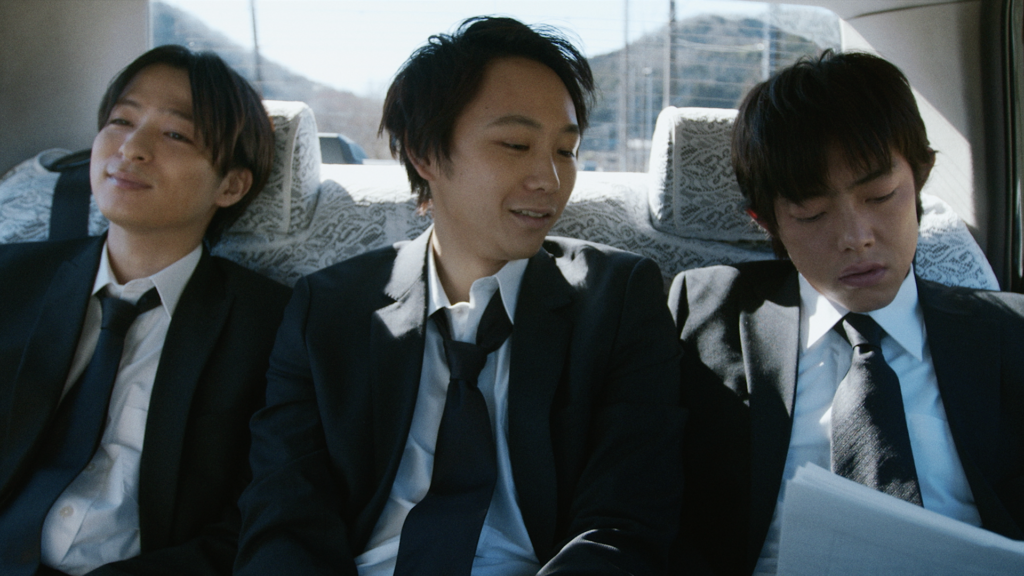
I THINK I’LL STAY THERE / SOKO NI IYOU TO OMOU (By Kaye)
Dir. Hayashi Takayuki (2022, ML-Vol.3)
Cast: Yoshimura Kaito, Suga Kenta, Da-iCE Wada Hayate, Murata Hideaki
@SAKKA
What was likely expected to be just another taxi trip with old classmates after the funeral of a mutual friend, quickly turns uncomfortable for Manabu (Yoshimura Kaito) as the conversation topic goes from his students’ ‘dream for the future’ papers – and then his role as the baseball team coach – to their own past with baseball. One of his friends (Suga Kenta) admits he felt like they had nothing to show for all the time they’d devoted to it, and is quick to try and blame others for giving them false hope and not telling them to give up and focus on something else. As a result, the friend’s clear bitterness – and perhaps even resentment towards Manabu still continuing their dream in some form – have him tell the guy not to make the same mistake with his own students. Manabu, however, has his own feelings attached to the matter.
Director Hayashi Takayuki keeps the setting simple: most of the film happens on the backseat of a taxi with the main focus on Yoshimura’s character, who can’t do anything but face the words and thoughts of his old friends, as the mood increasingly becomes heavier the more minutes roll past. On one end, there’s frustration at the thought Manabu did not move on from baseball along with them, while on the other there’s also clear confrontation with the fact they’ve simply grown apart. The friends are split in more ways than one, a detail the film manages to easily get across visibly as well. With a near sole focus on Manabu for most of the first part of the story – even when the other two are talking – it’s already established he’s somewhat disconnected from his old friends. When Manabu then continues the ride on his own after a scuffle – and a full backseat is finally shown – the emptiness is expected, but still confronting.
As they head on, the taxi driver easily picks up on the overall issue, and adding his own angle to the subject seemingly confirms for Manabu that something doesn’t only have meaning if there’s great achievements tied to it. That sometimes it’s fine to let the good memories and feelings be the decisive factor, and that, perhaps, for him, those feelings attached are worth more and enough to become a place where he could at least go, “I Think I’ll Stay There”.
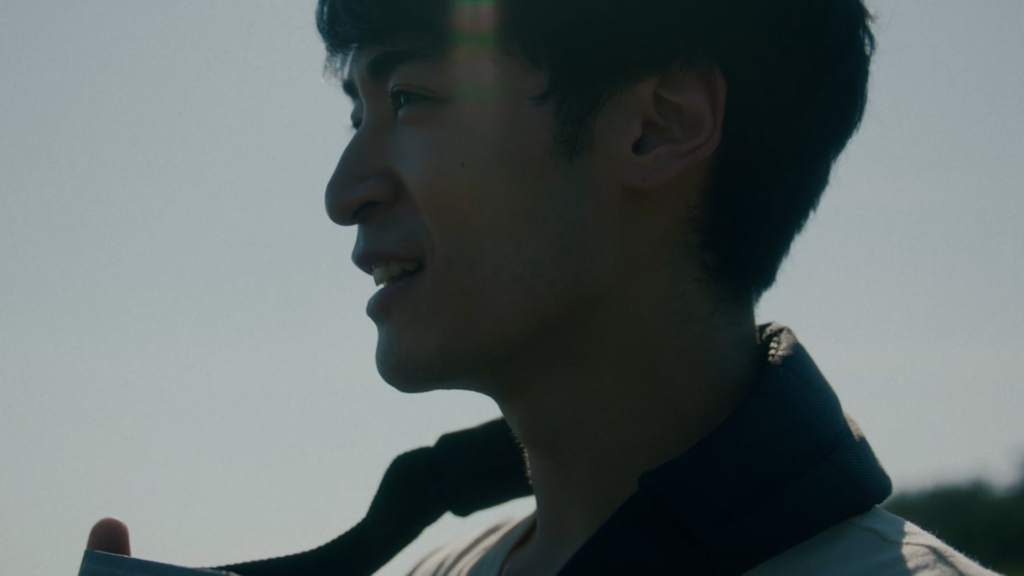
NAMONAKI ITSUPEN – TOKYO MORATORIUM (By 50)
Dir. Fujii Michihito (2022, ML-Vol.4)
Cast: Wakabayashi Takuya, Miura Kento, Maeda Oshiro, Sonoda Aika, Hirooka Hijiri
@SAKKA
This was a comfortable watch and a fitting start to MIRRORLIAR FILMS Vol.4, prompting me to reflect on the mindset I can carry during the viewing of the rest of the volume. Although the plot is simple, the message delivery is to the point and executed elegantly. I would say the directing stands out the most, and I expect no less from someone of Dir. Michihito’s calibre.
We open with our protagonist Takuya (Wakabayashi Takuya) smoking on the balcony and giving his partner non-committal answers as if nothing can raise his interest. We get a sense that passion on all fronts–romantic and career-wise–is slowly dying within Takuya. He is detached and disinterested.
He meets up with old friends with whom he created amateur films when he was younger, and the conversation takes a turn towards wondering how the other absent friends are faring. Dir. Michihito’s deliberate choice to cut to Takuya’s expression at this moment when it is mentioned that their friend’s husband is doing well is sublime, especially since we saw Takuya and his partner just a moment before and he wasn’t doing well on all fronts. Up to this point, many subtle moments peppered throughout help build up the undercurrent of disconnect in a skilful display of “show, not tell” and before we know it, the mood has been set up beautifully.
The other thing that stands out right from the start is the choice to use grayscale monochrome for the present day sections and letting colour slowly seep in whenever we cut to the scenes of their youth. Everything in the coloured sections also has an idealised tinted filter akin to a music video with slow motion, laughter and minimal dialogue. This makes present day feel even more lifeless and dreary, which seems to be the atmosphere that Michihito is trying to convey. The contrast between the days of romantic youth and reality are further juxtaposed when they do similar activities but are thrown back to present time when the scene cuts from a close up of the same item to a wide shot of them lounging on urban concrete, with the emptiness of the surplus space loudly reinforcing the detachment we pick up from Takuya.
Throughout the film, there are also repeated motifs that attract my attention. The lines “Why do you smoke?” and “Men smoke to disguise their sighs” are referenced in multiple ways, offering varying lenses to interpret through: the awkwardness of Takuya as an amateur scriptwriter-director; the good-natured teasing between old friends; the monotonous interaction between Takuya and his partner. These lines follow Takuya from his young idealistic days to his current jaded state, reflecting how interpretations evolve as one gains life experiences and signaling the change that he and his friends undergo. It is likely none of them fully grasped those lines and the heaviness they held back then, evidenced by the stark difference between their energy then and now. Another repeated motif is Takuya’s friend reminiscing about their fun old times and acting as the voice of Takuya’s inner thoughts. There is pensive subtext hidden under his words and it is revealed on the second occasion that he is saddled with other concerns in life and no longer as freewheeling as he’d like to be. As Takuya’s friend declares, the “fun” times are coming to an end. These motifs add the finishing touch to the keyword of the film: moratorium, implying that the life season Takuya and his friends are in are a mere break, that these carefree youthful days are but a temporary respite. A respite that is bound for an ending, after which responsibilities and cares of the world potentially return to the shoulder. The future, full of uncertainty. This is not an uncommon trope but Michihito navigates this without losing sight of the core message he wishes to convey and falling into cliché preaching. Losing the fearless passion and innocence of youth is a coming-of-age transition with a slow pain that gnaws at us as we gradually realise that things like duty, obligation, illness and failure exist.
The usage of the two motifs serves the film well with the latter picking up in the second half as the film moves towards a hopeful direction. Takuya receives a timely wake up call regarding his mindset, that while he has things to work on, having fun in the process is important. Dir. Michihito appears to argue that just because youth is ending or that the going gets tough, it does not mean that we wallow in self-limiting beliefs, and we can take control of what is to come just as well as we did when we were younger. Verily, the future is uncertain. But being at the crossroads means opportunity. Fun is important. So is the journey of getting to where we want to be. If we decide to prioritise and make space for this in our lives, what welcomes us might be a new beginning. Feeling equally inspired, both Takuya and I return to the computer in our parallel universes and begin typing our own thoughts with a smile on our faces.

Although we only covered three out of 18 short films available, we can confirm the entire experience is a true feast for the eyes and mind to discover. So mark the dates and don’t miss it!